
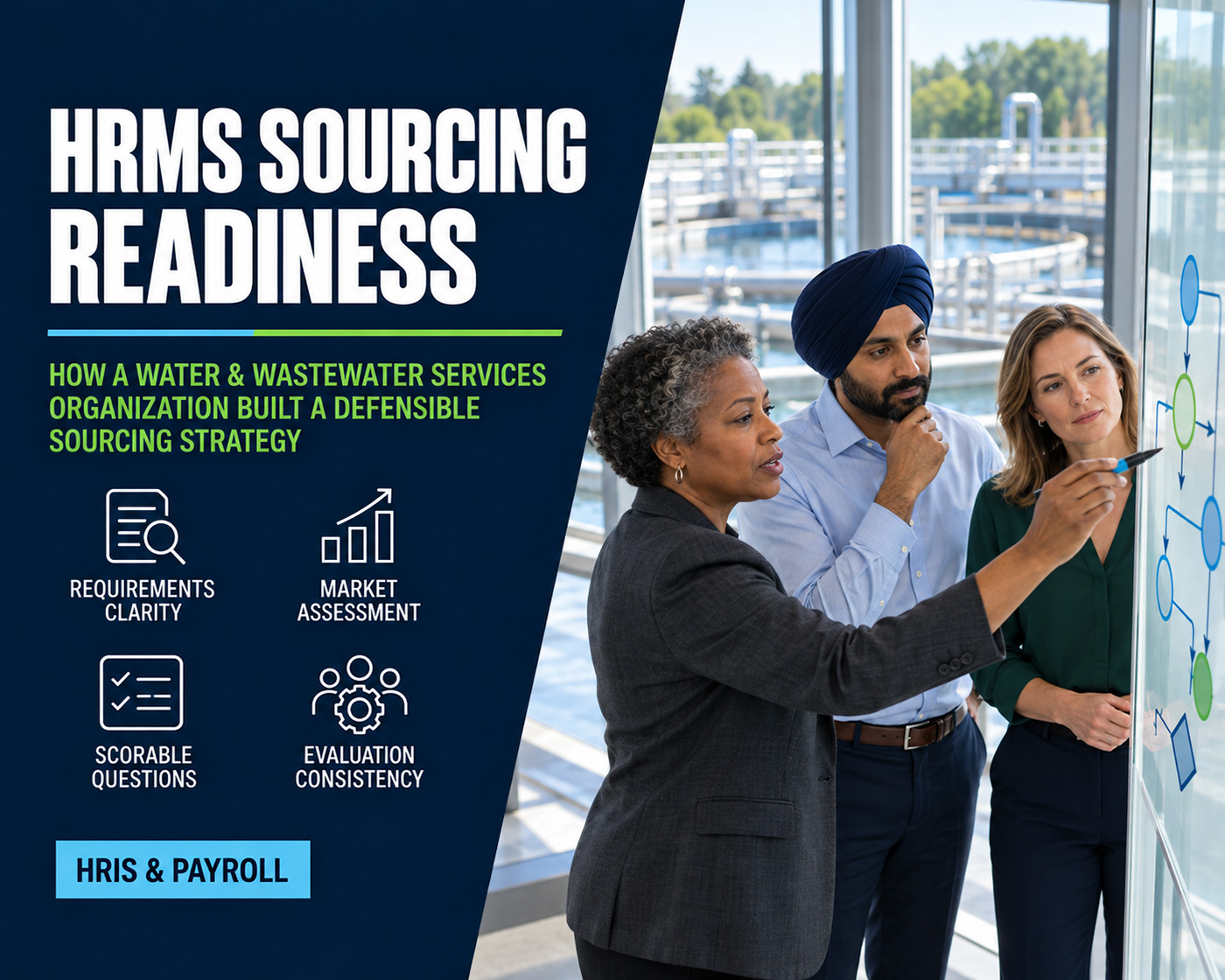
OCWA Technology Sourcing & Selection
Client Profile
The Ontario Clean Water Agency provides water and wastewater operations and maintenance services to municipalities and private-sector clients across Ontario. At the time of the engagement, more than 800 employees worked across a corporate office and 11 regional hubs, supporting facilities that ranged from small well systems and lagoons to large systems serving millions of people.
Executive Summary
Major technology decisions often fail before suppliers ever enter the room. If requirements are incomplete, evaluation questions are ambiguous, or the market approach does not reflect operational realities, even a well-run competitive process can produce the wrong shortlist.
OCWA faced that risk as it prepared to modernize human resources processes and technology within its broader Business Transformation Program. HR information was distributed across multiple systems, databases and paper-based processes. The future solution also had to serve a geographically dispersed workforce, integrate with existing applications, support frontline employees with limited computer access, meet public-sector security and accessibility expectations, and preserve flexibility for capabilities that could be added later.
ProcurePro was engaged to help OCWA define what the organization needed, test those needs against the HRMS marketplace, and translate them into a defensible two-stage sourcing package. The completed work included a detailed requirements framework, market assessment, request for pre-qualification documentation, refined rated questions, and evaluator guidance.
The engagement concluded when ProcurePro handed the completed sourcing package to OCWA's procurement team. OCWA then assumed responsibility for issuing and managing the competitive process. ProcurePro did not participate in supplier evaluation, selection, contract negotiation or implementation, and this case study makes no claim regarding those later stages.
The Challenge
OCWA was not simply replacing an HR application. Leadership was preparing for a broader transformation of how the organization attracted, onboarded, developed, supported and managed employees across a distributed operating environment.
The current landscape included disparate platforms and databases supporting payroll, benefits, performance, talent, recruitment, learning and employee information. Some processes relied on email, paper tracking and standalone databases. At the same time, several government-mandated systems had to remain in place, which meant the future HRMS needed to integrate with the existing environment rather than assume a clean replacement of every component.
The required scope was extensive. It covered recruitment, onboarding and offboarding, employee status changes, leaves and return-to-work processes, learning and certification tracking, labour relations, succession, performance, engagement, scheduling, reporting, analytics, security, workflows, auditability and system administration. OCWA also wanted the chosen platform to accommodate potential future requirements in payroll, pension, benefits and talent-related functions, even where implementation was not immediately in scope.
This created a difficult decision-design problem. Requirements had to be comprehensive without predetermining a supplier or architecture. Questions had to distinguish real capability and implementation fitness without confusing respondents. The market approach also had to support an open, fair and defensible public-sector process.
Why ProcurePro was Engaged
OCWA needed an independent advisor that could connect business needs, technology capabilities, supplier-market realities and competitive-process discipline.
Unlike software vendors, implementation partners, systems integrators or resellers, ProcurePro had no financial interest in which HRMS provider advanced. Its role was to sit on OCWA's side of the table, challenge assumptions, improve the quality of the requirements and sourcing documents, and help the organization approach the market with a clear and supportable framework.
That independence was particularly important because the marketplace included both large enterprise platforms and Canadian mid-market providers. OCWA needed a process that allowed different solution and delivery models to be assessed consistently against its actual requirements.
How ProcurePro Helped
DEFINE
ProcurePro helped convert OCWA's transformation objectives into a structured set of business, functional, technical, security, integration, reporting and operational requirements. The requirements were organized by functional area and prioritized to distinguish immediate needs, lower-priority needs and future capabilities.
This work gave OCWA a common definition of success across Human Resources, Business Transformation, Information Technology, Operations and Procurement. It also clarified important constraints, including required integrations, data residency considerations, role-based security, audit trails, mobile accessibility, bilingual capability, configurable workflows and the needs of frontline employees who were not routinely at a computer.
ASSESS
ProcurePro assessed the HRMS marketplace against OCWA's size, Canadian operating context, multilingual needs, cloud direction, public-sector experience and required functionality. The research considered both enterprise and mid-market providers and documented the rationale for including potential respondents in the competitive process.
ProcurePro then helped translate the requirements and market findings into a two-stage sourcing structure. The first stage was designed to pre-qualify up to three respondents based on experience, organizational fit, solution capability, implementation approach, security, integration, training, support and delivery readiness. A later invitational stage would allow OCWA Procurement to seek full bids from the shortlisted respondents.
The rated-question framework was restructured so that bundled, multi-part questions became separate and distinct questions. This reduced ambiguity for respondents and made evaluation more consistent. ProcurePro also created evaluator guidance that explained what raters should consider when assessing solution fit, implementation plans, resource requirements, security, integrations, training, support and long-term maintainability.
Together, these deliverables gave OCWA a coherent line of sight from business objective to requirement, supplier question and evaluation consideration before the opportunity was released to the market.
The Defining Decision
The most consequential decision was not which HRMS supplier to choose. ProcurePro's engagement ended before supplier responses were received. The defining decision was how OCWA should structure the market process so that a later supplier choice could be made on reliable evidence.
OCWA could have issued a broad request and asked the market to interpret the transformation need. That approach would have been faster initially, but it would likely have produced inconsistent assumptions, uneven responses and greater difficulty comparing enterprise suites, integrated module sets and implementation models.
Instead, OCWA chose to build the decision architecture first. Detailed requirements established what mattered. Market research identified credible provider categories. The RFPQ separated qualification from the later bid stage. Refined rated questions tested each respondent's experience, proposed solution, implementation capacity, security, integration, training and support. Evaluator guidance established a more consistent basis for scoring.
The result was a procurement-ready package designed to help OCWA narrow the market fairly and defensibly before seeking detailed bids. ProcurePro completed and handed off that package to OCWA Procurement, which issued and managed the process from that point forward.
Business Outcomes
Strategic Outcomes
- Converted a broad HR transformation objective into a structured, evidence-based sourcing strategy.
- Aligned business, technology and procurement considerations before market engagement.
- Preserved flexibility to consider a single integrated platform or multiple readily integrated tools.
- Created visibility into immediate requirements, lower-priority needs and future capabilities.
Sourcing and Risk Outcomes
- Produced a completed RFPQ package for handoff to OCWA Procurement.
- Improved response clarity by separating complex questions into distinct, scorable requirements.
- Strengthened evaluation consistency through detailed guidance for OCWA raters.
- Tested the supplier landscape before release and identified credible enterprise and mid-market provider categories.
- Reduced the risk of comparing suppliers on inconsistent scope, implementation and resourcing assumptions.
Operational Readiness Outcomes
- Documented extensive functional, reporting, security, workflow, audit and integration needs.
- Reflected the realities of a distributed workforce across a corporate office and 11 regional hubs.
- Included implementation planning, resource commitments, training, transition, service levels and post-go-live support in the qualification framework.
- Established a traceable foundation that OCWA Procurement could carry into the competitive process.
These outcomes represent sourcing readiness and decision quality. They do not imply that ProcurePro selected a supplier, negotiated a contract, oversaw implementation or validated realized operating benefits.
Why This Matters
Organizations evaluating an HRMS often focus first on product demonstrations. The stronger starting point is to define the operating problem, clarify what must integrate or remain in place, distinguish current from future scope, and decide what evidence suppliers must provide.
Independent HRIS selection consulting adds value before an RFP is issued because early decisions shape every later comparison. A structured requirements framework prevents high-profile features from overshadowing security, integration, implementation capacity, resource demands, user adoption and support obligations. Market assessment confirms whether the proposed scope is realistic and whether different classes of provider should be invited. Clear rated questions and evaluator guidance make responses easier to compare and scoring easier to defend.
For public-sector and regulated organizations, this preparation is especially important. Fairness and transparency must coexist with operational complexity, legacy dependencies, privacy requirements and long-term flexibility. Building the decision framework before going to market gives procurement teams stronger inputs and gives leadership greater confidence in the process that follows.
Planning an HRIS or HRMS Initiative?
ProcurePro can help you define the right technology strategy, objectively evaluate suppliers and negotiate stronger commercial and contractual outcomes.
Book a discovery session to discuss your project: https://outlook.office365.com/owa/calendar/ProcurePro@procurepro.ca/bookings/
For more information about our services please visit www.procurepro.ca