
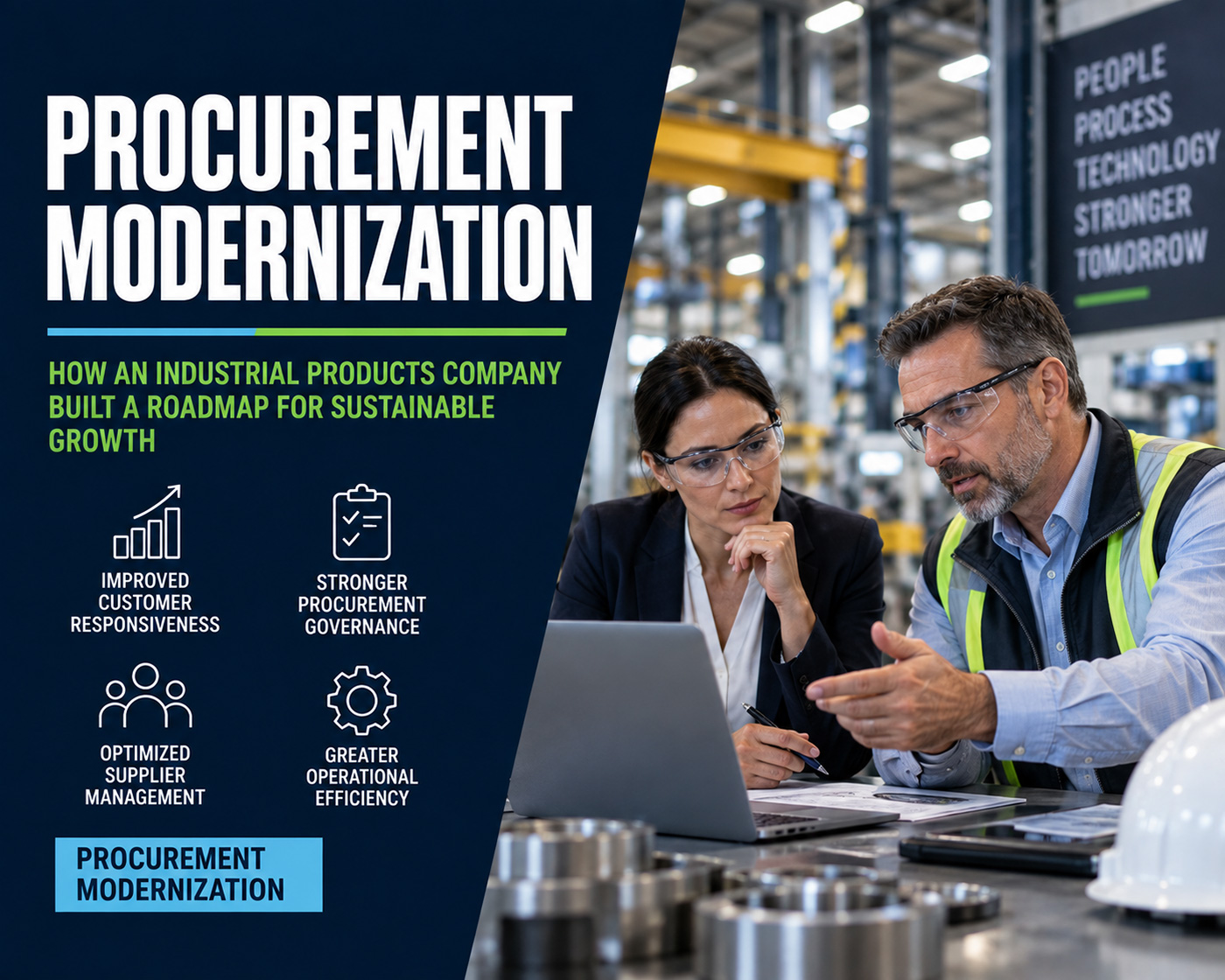
Procurement Modernization
Client Profile
The client is a North American industrial products company operating in a manufacturing and distribution environment. With approximately $30 million in annual revenue and approximately $5.5 million in annual procurement spend, the organization depends on effective procurement, supplier management and inventory planning to support customer responsiveness and business growth.
Approximately 85% of products sold were in/out items for resale. The organization processed approximately 400 customer quotes per month, with roughly half converting to orders. As the business evolved, procurement processes, organizational capabilities and supporting systems had not kept pace with the operational demands placed on the function.
Executive Summary
A leading industrial products company was experiencing procurement challenges that were affecting customer responsiveness, inventory planning, supplier management and operational effectiveness. When products were not in stock, confirming availability and pricing could take days and sometimes weeks. Leadership needed to determine whether these challenges could be addressed through isolated process or technology improvements, or whether procurement required broader transformation.
The assessment showed that technology alone would not solve the underlying issues. Procurement required coordinated improvement across people, processes, governance and systems, including clearer accountability, stronger procurement capabilities, documented policies and procedures, more disciplined supplier and contract management, improved inventory planning and better Source-to-Pay visibility.
ProcurePro Consulting conducted an independent procurement modernization assessment and developed a phased roadmap for transformation. The engagement provided leadership with an evidence-based view of the current state, a defined future-state operating model and practical recommendations for modernizing procurement in a way that could support customer service and long-term growth.
The Challenge
The assessment revealed that procurement challenges extended well beyond purchasing activities and were directly affecting the customer experience.
The organization processed approximately 400 customer quotes each month, with approximately 50% resulting in orders. When an item was not already in stock, obtaining product availability and pricing could take days and sometimes weeks. Customers needing immediate answers could go elsewhere, creating lost sales opportunities and affecting revenue, profitability and reputation. Out-of-stock conditions and pricing were identified among the leading reasons customers did not purchase.
Internally, the procurement team had experienced significant change, including the loss of senior, long-tenured resources and associated institutional knowledge. Roles and responsibilities were not clearly documented, formal procurement training was limited, the organizational structure did not differentiate strategic planning from tactical buying and expediting, and individual procurement performance goals were not established.
Procurement policies and procedures were also limited. Long-standing offshore supplier relationships had gone largely unmanaged and unchallenged, local suppliers were outside the procurement team's scope, and there was no evidence of consistent competitive bidding, category or spend management, supplier performance management, contract management or procurement scorecard and KPI measurement.
The supporting ERP environment was primarily limited to purchase order functionality. Inventory reports contained inconsistent data and limited planning intelligence, PO approvals were handled outside the system using spreadsheets, and the environment did not provide integrated capabilities for sourcing, inventory planning, supplier and contract management, spend analytics or other Source-to-Pay activities.
Why ProcurePro was Engaged
The organization required an independent advisor capable of assessing procurement holistically rather than approaching the problem as a technology implementation.
ProcurePro conducted one-on-one interviews with eleven subject matter experts across executive and senior leadership, sales, operations, accounting and procurement in Canada and the United States. Stakeholders were asked to identify procurement pain points, the impact on their roles and, most importantly, the impact on customers. ProcurePro also reviewed the existing ERP environment, including inventory planning, inventory and PO approval reports and the purchase order process.
This independent assessment enabled ProcurePro to:
- Evaluate procurement maturity across People, Process and Systems.
- Identify organizational, governance, process and technology gaps affecting performance.
- Assess how existing systems supported procurement and inventory planning.
- Define a future-state procurement operating model.
- Prioritize practical modernization initiatives.
- Develop a phased roadmap for transformation.
Rather than recommending isolated improvements or a technology-first solution, ProcurePro developed an integrated modernization strategy focused on building the organizational and operating foundation required to support sustainable procurement transformation.
How ProcurePro Helped
DEFINE
ProcurePro established a comprehensive understanding of the procurement environment through eleven stakeholder interviews, current-state analysis and review of the organization's procurement and inventory processes. The engagement examined organizational structure, roles and responsibilities, policies and procedures, supplier practices, inventory planning, procurement technology and customer impacts.
ASSESS
ProcurePro evaluated procurement maturity across People, Process and Systems. The assessment identified capability and training gaps, unclear accountability, limited procurement governance, unmanaged supplier relationships, lack of category and spend management, insufficient performance measurement, fragmented inventory planning, manual workflows and significant limitations in the technology supporting Source-to-Pay activities.
TRANSFORM
ProcurePro developed a future-state model and phased modernization roadmap. Recommendations included redesigning the procurement organization to distinguish strategic and tactical responsibilities, strengthening procurement leadership and accountability, developing job descriptions and training, establishing procurement policies and procedures, introducing category management and competitive sourcing practices, strengthening supplier and contract management, improving inventory planning, creating procurement KPIs and scorecards, improving existing ERP data and purchasing practices, and evaluating point solutions to extend Source-to-Pay capabilities.
Final Recommendation and Engagement Status
ProcurePro recommended a coordinated procurement modernization program spanning People, Process and Systems.
The recommended future state included an enhanced procurement organization with clearer strategic and tactical responsibilities; formal roles, goals, training and performance measures; updated procurement policies and procedures; stronger category, supplier, contract and inventory management practices; improved use of the existing ERP environment; and targeted Source-to-Pay capabilities for functions such as inventory planning, competitive sourcing, spend analytics, savings tracking and supplier and contract management.
The recommendations were organized into a phased roadmap intended to provide leadership with a practical sequence for modernization. ProcurePro's documented engagement covered the assessment, recommendations and roadmap.
The Defining Decision
Building the Foundation for Procurement Transformation
The defining decision was whether the organization should treat its challenges as a collection of isolated process and system problems or establish the operating foundation required for broader procurement transformation.
The assessment demonstrated that technology alone could not address unclear roles and accountability, capability and training gaps, limited policies and procedures, unmanaged supplier relationships, fragmented inventory planning and the absence of meaningful procurement performance measures.
ProcurePro therefore recommended strengthening the procurement operating model first and aligning people, processes, governance and enabling technology through a phased roadmap. This approach positioned future technology investments as an enabler of a stronger procurement function rather than a substitute for one.
Business Outcomes
The engagement gave leadership a structured, evidence-based view of the procurement function and a practical future-state roadmap.
Strategic Outcomes
- Established a comprehensive view of procurement maturity across People, Process and Systems.
- Identified material gaps in organizational capability, governance, supplier management, inventory planning, performance measurement and supporting technology.
- Defined a future-state procurement operating model with clearer strategic and tactical responsibilities.
- Established modernization priorities across organizational design, policies and procedures, supplier and contract management, inventory planning, procurement systems and performance measurement.
- Provided a phased roadmap to guide procurement modernization over time.
Operational Roadmap
- Redesign procurement roles to distinguish strategic planning and category responsibilities from tactical buying and expediting.
- Develop formal job descriptions, individual goals, training and procurement performance measures.
- Update procurement policies and procedures covering authority, inventory management, competitive bidding and contract management.
- Introduce stronger category management, competitive sourcing, negotiation, supplier management and contract management practices.
- Improve inventory data, planning practices and purchasing information within the existing ERP environment.
- Evaluate targeted Source-to-Pay capabilities for inventory planning, sourcing, spend analytics, savings tracking, and supplier and contract management.
Expected Business Impact
- Improve customer responsiveness by strengthening access to reliable product, pricing and availability information.
- Increase procurement accountability, visibility and performance measurement.
- Strengthen inventory planning and purchasing discipline.
- Improve supplier governance and commercial management.
- Create greater visibility across Source-to-Pay activities.
- Build a more scalable procurement operating model aligned with business growth.
Why This Matters
Procurement modernization is often treated as a technology problem. But fragmented processes, unclear accountability, weak supplier governance, limited inventory visibility and capability gaps cannot be solved by software alone.
For CFOs, COOs and transformation leaders, the more important question is whether the procurement operating model, governance, processes and capabilities are ready to support the business and make effective use of enabling technology.
This engagement demonstrates the value of assessing People, Process and Systems together. By identifying the root causes behind procurement performance and translating them into a phased modernization roadmap, leadership gained a practical foundation for strengthening procurement and supporting sustainable growth.
Ready to Modernize Procurement?
Procurement modernization starts before technology selection. Before investing in Source-to-Pay technology or redesigning procurement processes, organizations need a clear understanding of their current capabilities, operational gaps, governance requirements and future-state objectives.
ProcurePro provides independent procurement and technology advisory services to help organizations assess their current state, define the right future-state model and build a practical roadmap for transformation.
Book an Executive Consultation
For more information about our services, visit www.procurepro.ca